Third grade has a reputation, and it’s earned. It’s the year math stops being mostly about counting and becomes about structure — the year of multiplication, fractions, and the first math that many parents find themselves re-learning at the kitchen table.
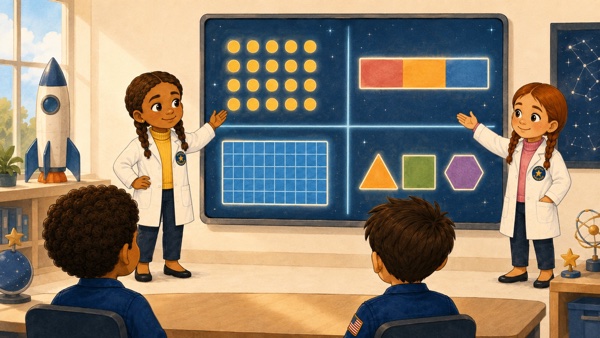
Here’s the whole year in plain English. The official standards organize 3rd grade math around four “critical areas,” and once you know them, everything your child brings home will fit into one of four buckets. (Pacing and order vary by school and curriculum, so treat this as the map, not the calendar.)
1. Multiplication and division within 100 — the headline
This is the big one, and it comes in two layers.
The first layer is understanding: your child will learn what multiplication is — equal groups, rows-and-columns arrays, “4 bags of 5 apples.” Division arrives as the same idea in reverse: 20 apples, 4 bags, how many in each? Expect drawings, arrays, and story problems before naked equations. That’s by design.
The second layer is fluency: by the end of the year, the standards (3.OA.C.7) expect kids to know all products of two one-digit numbers from memory. That means the times tables — memorized, no counting. Understanding comes first, but knowing the facts by heart is where the year is headed.
How to help at home: short, frequent fact practice beats marathon drills, and memory tricks help — our Jenny’s Rules post lists a strategy for every table.
2. Fractions — as numbers, not pizza slices
Your child has seen halves and quarters before. What’s new in 3rd grade is the idea that fractions are numbers — they live on the number line between the whole numbers. The standards build everything from “unit fractions” (1/2, 1/3, 1/4), the way whole numbers are built from 1.
Expect comparisons that hinge on the size of the whole: 1/3 of a ribbon is longer than 1/5 of the same ribbon — but 1/2 of a small bucket of paint can be less than 1/3 of a big one. If your child comes home saying a bigger denominator means smaller pieces, the year is going well.
How to help at home: cooking is the easiest place to practice. Ask “is 1/3 cup more or less than 1/4 cup?” — then pour the water and let your child see the answer. One session with real measuring cups teaches more than a page of fraction problems.
3. Area — where multiplication grows a shape
The third big idea connects arithmetic to geometry: cover a rectangle in unit squares, count them, and discover you didn’t need to count — rows times columns does it. Area is multiplication you can see, and it’s many kids’ favorite unit for exactly that reason.
Perimeter tags along, and so does the classic mix-up between the two. (Perimeter is the fence; area is the grass.) Your child will also work with time to the nearest minute, elapsed time, liquid volume, mass, and reading simple graphs — the measurement-and-data bucket.
4. Shapes — the quiet fourth
The smallest bucket: describing and classifying two-dimensional shapes by sides and angles, and connecting shapes back to fractions by splitting them into equal parts. It’s a breather unit, and it lays groundwork for later geometry.
What good support looks like this year
- Guard the addition facts. Multiplication leans on them all year. If 8 + 5 still requires fingers in September, that’s the first fix — see our readiness checklist for how.
- Little and often. Ten minutes of facts practice a few times a week, all year. Consistency is the whole game.
- Let story problems be stories. Third grade math is full of situations — bags, arrays, ribbons. Kids who talk through the story solve more than kids who hunt for numbers to smash together.
- Watch for the wall. If frustration becomes the norm rather than the exception, look at our guide to signs your child is falling behind — early conversations with the teacher beat spring surprises.
A year of missions
Mission Control Math was built for exactly this year. Every worksheet is part of a space mission, and your child has to do the multiplication to launch the satellite — math is how the story moves forward.
Try a free sample mission — the 2s times-table set with its answer key.
Send the free sample mission
The 2s times-table worksheet set from the Multiplication Workbook, with answer key — straight to your inbox.
Check your inbox!
Your free sample is on its way to . If you don’t see it, check your spam folder.
Ready for the full program? Both workbooks are on Amazon.
See the workbooks on Amazon →