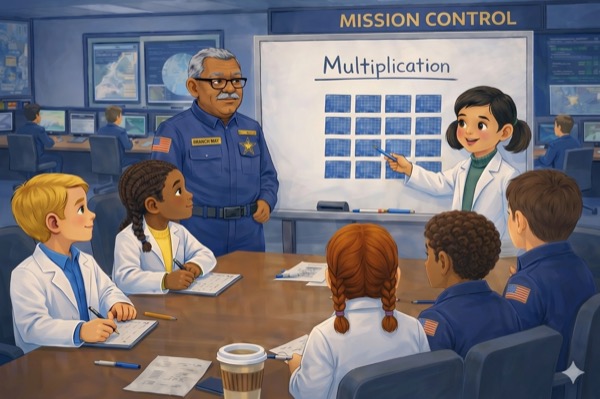
In the Mission Control Math Multiplication Workbook, there's a character named Jenny — or Ms. Huang, depending on how formal you want to be. She's flown in from Mission Control Florida specifically because the Rangers need to learn their times tables, and she has a memory trick for every single one.
That character exists because the problem she solves is real.
Most kids are handed a times table chart and told to memorize it. Some do. Many don't. And the ones who don't often struggle with all the math that depends on multiplication — fractions, long division, algebra — for years afterward. The gap isn't intelligence. It's that nobody gave them a handle.
These are the handles.
What's in the Multiplication Workbook
Jenny introduces multiplication through arrays — rows and columns that show what multiplication means before the times tables are introduced. Then she covers three foundational rules every student needs before moving on to practice.
The zero rule: Any number multiplied by zero equals zero. If there are zero groups of anything, there's nothing.
The one rule: Any number multiplied by one stays the same. One group of something is just that something.
The commutative property: The order doesn't change the answer — 3 × 4 and 4 × 3 are both 12. This matters because it cuts the number of facts kids actually need to memorize nearly in half.
Additional tips to help at home
The workbook covers the foundations. Here are some additional rules and memory tricks worth keeping in your back pocket.
The 2s: doubling
The 2s are the first ones that really click for most kids once they realize it: multiplying by 2 is just doubling. 2 × 7 = 7 + 7. 2 × 8 = 8 + 8. If your kid can add, they can do the 2s. Frame it that way and watch the hesitation disappear.
The 5s: count by fives
Five is one of the most satisfying times tables to learn because the pattern is so obvious. Every answer ends in 0 or 5. Count by fives: 5, 10, 15, 20, 25... A kid who can count by fives can do every single 5s multiplication problem. Point that out explicitly.
The 10s: add a zero
Multiplying by 10 just adds a zero to the end. 10 × 4 = 40. 10 × 7 = 70. Once kids see this pattern, the 10s become almost effortless. (The harder skill is not applying this rule to the 9s and messing up — see below.)
The 9s: the finger trick (and the digit sum)
The famous finger trick: hold out all ten fingers. To calculate 9 × 3, fold down your third finger. You have 2 fingers to the left and 7 to the right: 27. It works for 9 × 1 through 9 × 10.
The backup rule: the digits of any 9s answer always add up to 9. 9 × 4 = 36 → 3 + 6 = 9. 9 × 7 = 63 → 6 + 3 = 9. If the digits don't add up to 9, the answer is wrong.
The 11s: repeat the digit
For single-digit multiplication: 11 × 4 = 44. 11 × 7 = 77. Just repeat the digit. It breaks down after 11 × 9, so teach the pattern for 1–9 and handle the rest separately.
The squares: spot the pattern
6 × 6 = 36. 7 × 7 = 49. 8 × 8 = 64. These are worth memorizing individually — they come up constantly. Some kids find it helpful to learn the squares as a separate group: 1, 4, 9, 16, 25, 36, 49, 64, 81, 100. Learn that sequence and the squares are just position numbers.
The tricky ones: 6×7, 7×8, 6×8
These are the facts kids miss most often. There's no elegant trick — they just need repetition. One mnemonic that helps some kids: 5, 6, 7, 8 → 56 = 7 × 8. Four consecutive numbers, and the last two are the product of the first two. For 6 × 7 and 6 × 8, there's no comparable trick — those just need to be drilled.
The rule that ties everything together
Every number in the times tables, up to 10 × 10, can be reached from a known fact by adding or subtracting one group. If a kid knows 7 × 7 = 49, they can figure out 7 × 8 by adding one more 7: 49 + 7 = 56. This is the failsafe. It's slower than memorization, but it works — and it teaches kids that multiplication is something they can reason through, not just something they either remember or don't.
"You don't have to memorize a fact you can figure out. But you'll go faster if you memorize the ones you use most." — Ms. Huang, Mission Control Math
Jenny's Rules in the Mission Control Math Multiplication Workbook cover all of these strategies in the context of the mission — each times table set includes a corresponding rule page before the practice problems begin.
Because understanding the trick is one thing. Practicing it until it's automatic is another. Both matter.
Send the free sample mission
The 2s times-table worksheet set from the Multiplication Workbook, with answer key — straight to your inbox.
Check your inbox!
Your free sample is on its way to . If you don’t see it, check your spam folder.
Ready for the full program? Both workbooks are on Amazon.
See the workbooks on Amazon →