Your child just looked up from their homework and asked the oldest question in math class. Here are answers that actually work.
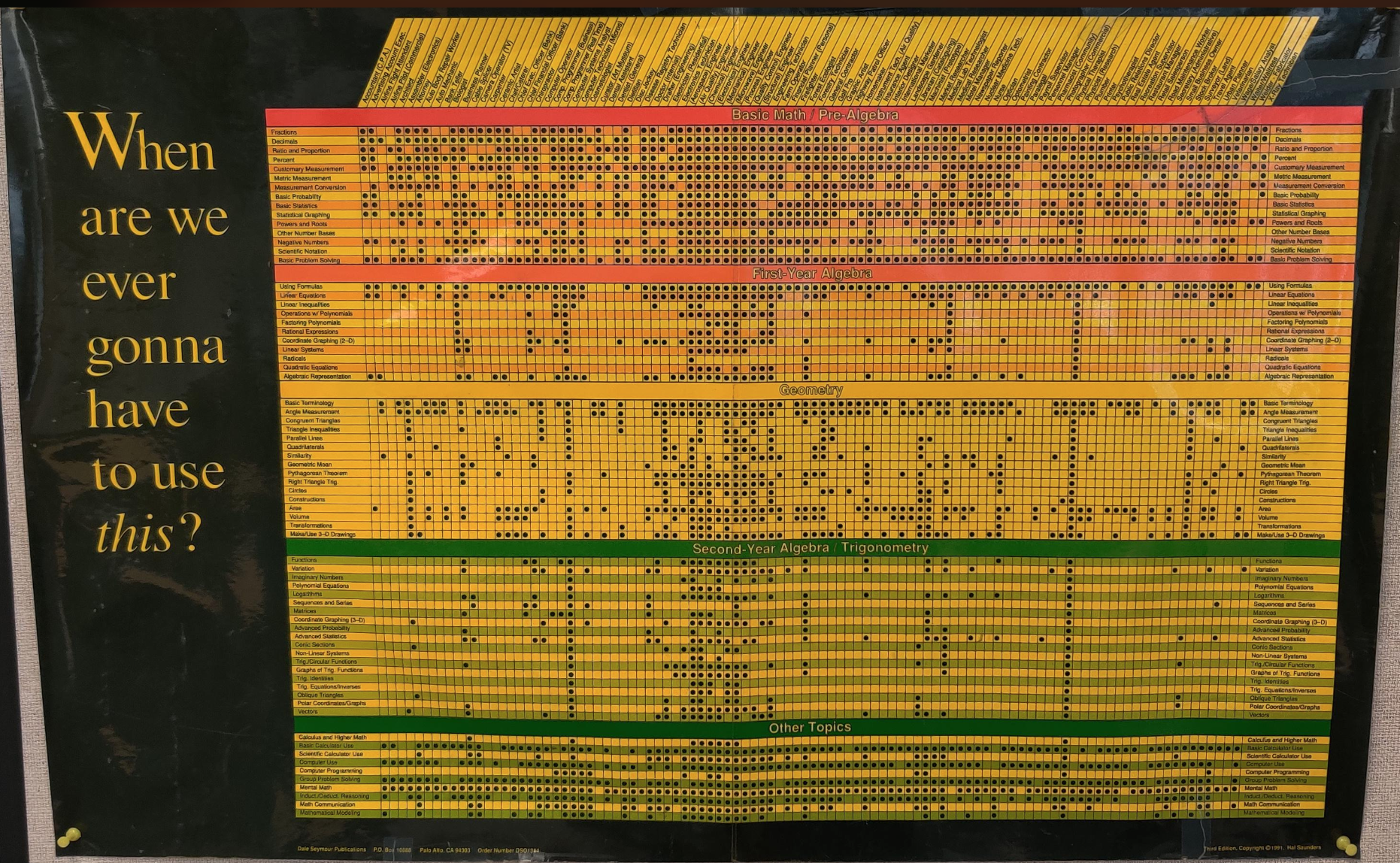
There’s a poster that hung in math classrooms across the country for decades. Published by Dale Seymour Publications, it was titled “When Are We Ever Gonna Use This?” — and it did exactly what the title promised. Math topics ran down one side. Occupations ran across the top. Dots marked every intersection where a topic showed up on the job.
Nurses needed fractions. Coaches needed statistics. Writers needed logic and estimation. The dots were everywhere.
Some teachers sent students to find their future career on that chart before they were allowed to sit back down. It worked — not because the chart proved math was useful, but because it made the usefulness visible.
That’s the real problem. Children don’t ask “when will I use this?” because they’re being difficult. They ask because the connection between the worksheet in front of them and the life ahead of them is genuinely hard to see. The answer isn’t “trust me.” The answer is specifics.
Here’s a grade-by-grade guide to the honest, concrete answers that actually land.
K–1: Counting and Addition
The easiest place to start, because the applications are immediate and tangible.
Children this age are already using math. Counting the fruit snacks to make sure their sister didn’t get more. Figuring out how many more days until their birthday. Adding up how many points their team scored.
What to say: “You used math at lunch today when you counted your crackers. That’s addition. We’re just learning to do it with bigger numbers.”
The goal at this stage isn’t to impress them with abstract futures — it’s to connect the skill to something they did today.
2nd–3rd Grade: Addition, Subtraction, and Multiplication
This is where the question starts coming up more often, because the math starts looking less like counting and more like work.
Addition and subtraction show up constantly in ways children care about: figuring out how much money they have left after buying something, keeping score in a game, tracking how many pages are left in a book.
Multiplication is where parents often get stumped for examples. Here are a few that actually resonate with children:
- Snacks for a party: “If we need 3 juice boxes per child and 8 children are coming, how many do we buy?” That’s multiplication.
- Video game scores: Many games multiply points by multipliers. Children who know their times tables can calculate their own score faster than the game does.
- Sports: A football team scored 4 touchdowns. Each is worth 6 points. What’s the score? Multiplication.
The concrete examples matter because they replace “you’ll need this someday” with “you already use this.”
What to say: “Multiplication is just a faster way to add the same number over and over. Once you know it, you’ll use it without even thinking about it — the same way you don’t think about tying your shoes anymore.”
4th–5th Grade: Division, Fractions, and Decimals
By 4th and 5th grade, children are old enough to hear slightly bigger-picture answers — as long as those answers are still concrete.
Division comes up whenever anything needs to be split equally: splitting a restaurant bill, dividing a bag of candy, figuring out how many teams you can make from a group of players.
Fractions are everywhere in cooking. A recipe that serves 4 needs to be doubled for 8 people. That’s fractions. Cutting a pizza into equal slices is fractions. Understanding a sale that says “½ off” is fractions.
Decimals show up every time money is involved — and money is the most persuasive argument for almost every elementary math topic. Counting change, comparing prices, calculating tax, splitting costs with a friend.
What to say: “Every time you buy something, you’re using decimals. When you figure out if you have enough money, that’s subtraction. When you compare two prices to find the better deal, that’s math. You’re already doing it.”
The Bigger Answer (For When They’re Still Not Convinced)
Sometimes children aren’t really asking about usefulness. They’re asking because they’re frustrated. The math is hard, and “when will I use this?” is an easier thing to say than “I don’t understand this.”
For those moments, the most honest answer is this: math teaches your brain to solve problems it’s never seen before.
That skill — breaking something complicated into steps, finding what you know, working toward what you don’t — is useful in every job, every decision, and every hard conversation a person will ever have. It’s not just about the numbers.
That answer works best for older children, delivered calmly and without a lecture.
A Note for Parents Who Hated Math Themselves
If math wasn’t your subject, it can feel impossible to answer these questions with confidence. That’s normal, and it doesn’t mean you can’t help.
The most important thing isn’t having the perfect answer. Saying “yeah, I never used it either” closes the door. Saying “let’s find where it shows up” keeps it open.
Try connecting it to something that already happened that day. If your child counted out money at the store, that’s subtraction and decimals. If they helped measure ingredients for dinner, that’s fractions. If they calculated a score in a game or figured out how many points their team needed to win, that’s addition and multiplication. The math on the worksheet is the same math — just written differently on paper.
Mission Control Math workbooks are designed to help 3rd graders build real math fluency — through story, strategy, and the kind of practice that actually sticks.
Browse the Series on Amazon →Send the free sample mission
The 2s times-table worksheet set from the Multiplication Workbook, with answer key — straight to your inbox.
Check your inbox!
Your free sample is on its way to . If you don’t see it, check your spam folder.
Ready for the full program? Both workbooks are on Amazon.
See the workbooks on Amazon →