Ask most parents what homework time looks like and you’ll hear the same story. Someone stalls. Someone gets frustrated. Someone says they don’t understand. Someone says they don’t care. By the time the worksheet is done, nobody feels good about it.
That’s not a parenting failure. It’s what happens when a child is handed something hard and told to do it alone.
Mission Control Math was designed with that moment in mind. These aren’t workbooks you hand your child and walk away from. They’re workbooks you sit down and read together.
Homework as a reading session
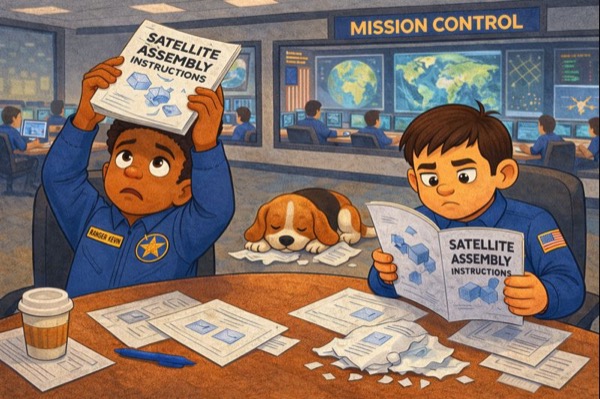
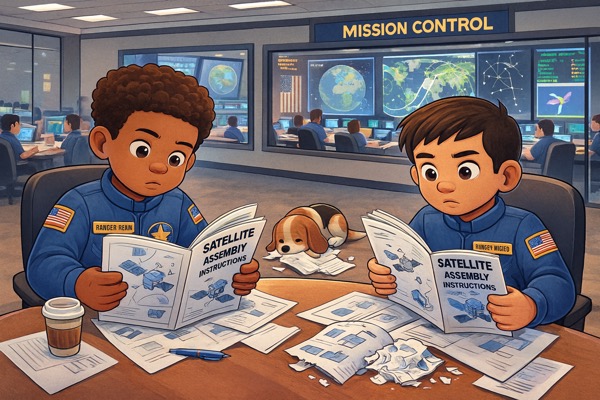
Every Mission Control Math workbook opens with a story. Kevin and Mateo are Space Rangers — 3rd graders on assignment who have gotten themselves into real trouble — and the only way out involves math. The problem sets aren’t interruptions to the story. They’re the way the story moves forward.
That structure changes what homework time can look like. Instead of handing your child a packet and waiting for the complaints to start, you sit down together and read. What’s going to happen to Kevin and Mateo? How are they going to fix the loading dock? What would you do if you were on the crew?
Families who read together already know this rhythm. It’s the same one as a bedtime story — one person reading, another listening, both invested in what happens next. Mission Control Math runs on that same engine.
You don’t have to be a math person
One of the quieter stresses of homework time is the parent who isn’t sure they remember how to do the math. Regrouping. Arrays. The commutative property. It’s been a while.
Here’s the thing: you don’t need to remember any of it to read the story alongside your child. The characters explain the concepts as part of the plot. Engineer Ava walks Kevin and Mateo through place value the same way she’d explain it to a new crew member — from the beginning, without assumptions. Jenny — Ms. Huang — teaches multiplication the way it actually makes sense, starting with arrays and repeated addition before the times tables come in.
You’re not tutoring. You’re reading with your kid. The workbook does the teaching.
The dynamic shifts when you’re on the same team
When a parent sits down at the table and says “let’s figure this out together,” something changes. Your child isn’t alone with something hard. You, their parents, aren’t the enforcers. You’re both trying to help Kevin and Mateo get through the mission.
That’s not a small thing. A lot of homework frustration comes from children feeling like they’re supposed to already know something they don’t. Sitting alongside them — reading the same story, encountering the same concepts together — removes that pressure. You’re both learning.
You’re both on the crew.
Short enough to finish together
The problem sets in Mission Control Math are designed to be short. Not because the math is easy, but because finishing matters. A child who completes a problem set feels capable. A child who gives up halfway through doesn’t.
For parents, short problem sets also mean a homework session that has a real end. Fifteen minutes, one problem set, one story section. You can both see the finish line from the beginning — which makes it a lot easier to stay at the table.
The reward at the end
In the Multiplication Workbook, the team tests the satellite’s ability to send and receive signals by solving cryptogram puzzles at the end of each times table. Correct answers to problems provide keys to decoding the message. Solve the math, decode the message.
Decoding it together is the kind of moment that makes homework feel less like homework. It’s a small payoff — a funny or inspirational message hidden in the problem set — but it’s a shared one. You both worked for it. You both get to laugh, or be inspired by what it says.
That’s the version of math practice that builds confidence. Not obligation. Not enforcement. Something your child actually wants to do again tomorrow.
Send the free sample mission
The 2s times-table worksheet set from the Multiplication Workbook, with answer key — straight to your inbox.
Check your inbox!
Your free sample is on its way to . If you don’t see it, check your spam folder.
Ready for the full program? Both workbooks are on Amazon.
See the workbooks on Amazon →