Pick up any supplemental math workbook and flip through it. You’ll find the same thing in almost all of them: rows of problems, maybe a cartoon mascot, and a lot of white space. They work — if your child will do them. That’s a big if.
Mission Control Math was built on a different premise: if stories are how we teach kids everything else that matters, why should math be the exception? These workbooks use characters, plot, and a genuine story arc to pull kids through the problem sets — not as decoration, but as the reason to keep going.
The Addition Workbook: stranded in space
Kevin and Mateo are 3rd grade Space Rangers who have been grounded due to poor homework performance. They’re stuck on a nearby planet and need help repairing their rocket.
The Addition Workbook opens with a review of second grade math, which builds confidence before moving into three and four-digit addition with regrouping — the grade-level skills they need to repair their rocket and return home.
Mr. Command, their grumpy but caring mission director, doesn’t leave them to figure it out alone. He introduces them to Engineers Ava and Emily, who walk them through place value and regrouping — the exact addition skills they need to master 3rd grade math. Andy, the team’s quality assurance specialist, is along for the ride too, offering helpful tips throughout the workbook, and reminding kids to ask a parent or teacher if they get stuck and need help.
Kids working through the Addition Workbook aren’t grinding through worksheets. They’re helping Kevin and Mateo get back home.
The Addition Workbook is available now on Amazon.
The Multiplication Workbook: the satellite parts ordering disaster
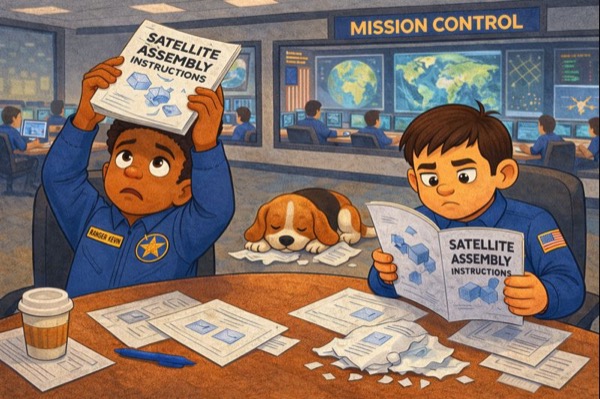
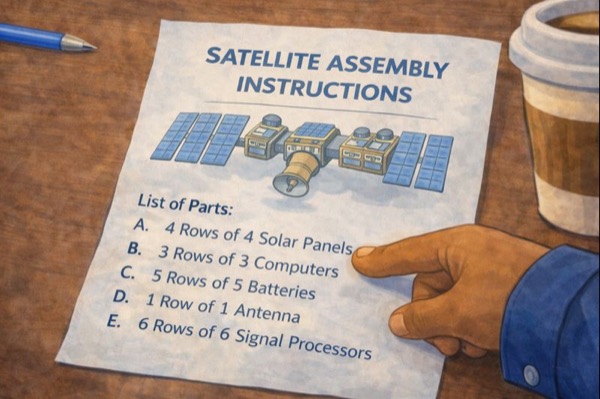
The Multiplication Workbook starts with a bigger problem. Mission Control is building a new satellite, and Kevin and Mateo are responsible for ordering the parts. Things go sideways fast: the loading dock is completely overrun with deliveries, and nobody can make sense of the quantities.
From the workbook
“Well, let me ask you something,” Ava said. “How many solar panels does our satellite need?”
“Sixteen!” Kevin said proudly, checking his notes.
“And how many times did you order four solar panels?” Ava asked.
Kevin and Mateo looked at each other, confused.
“Um… four times?” Mateo said slowly. “We ordered them on Monday, Tuesday, Wednesday, and Thursday.”
Ava nodded. “So if you ordered four solar panels four different times, how many shipments of solar panels are arriving?”
Kevin’s eyes went wide. “Oh no.”
Mateo’s face turned red.
“Four separate shipments of solar panels, three separate shipments of computers, six separate shipments of signal processors…” Ava said, reading from her list.
Kevin put his head in his hands.
“We’re sorry!” both boys said together.
Ava smiled. “It’s okay. But this is why we need to learn multiplication. If we understand how numbers work together, we won’t make mistakes like this.”
Mateo groaned. “Mr. Command is going to kill us.”
“Probably,” Ava agreed, “but at least we’ll have plenty of boxes for Cooper to play with!”
Kevin and Mateo couldn’t help but laugh.
Mr. Command brings in a specialist. Jenny Huang — (pronounced Wong) — is flown in from Mission Control Florida because she’s the best multiplication expert at Mission Control. She doesn’t just drill the times tables. She teaches multiplication the way it actually makes sense: starting with arrays and repeated addition before moving into times tables. She covers the zero rule, the one rule, and the commutative property (why 3×4 and 4×3 give you the same answer) — the foundations that make everything else click.
As part of Mission Control’s motto — Design, Test, Fly — the Rangers must prove their satellite can send and receive signals before it launches. That’s where the cryptogram puzzles come in. Solve the problem set, earn the decoding key, reveal the message. It’s a reward that’s built into the work itself, not tacked on after.
Why story-driven practice works
There’s a reason kids abandon drill packets halfway through or click through online practice screens as fast as possible. Those methods ask children to do something hard for no reason other than because it’s good for them. That’s a tough sell at homework time.
Mission Control Math is built around interest instead of obligation. Kids want to find out what happens next. The math is what gets them there.
The problem sets are short and focused by design — small enough to actually finish, which matters more than most parents realize. Finishing one problem set builds the confidence to start the next one. That loop is what creates consistent practice, and consistent practice is what produces results.
Kevin and Mateo are funny, they struggle with math, and their problems are relatable. Kids working through these workbooks aren’t alone with a problem set. They’re part of the crew.
Math practice doesn’t have to feel like homework.
Mission Control Math wraps real 3rd grade skills inside a space adventure your child will want to come back to — one short problem set at a time. Both workbooks are available now on Amazon.
Send the free sample mission
The 2s times-table worksheet set from the Multiplication Workbook, with answer key — straight to your inbox.
Check your inbox!
Your free sample is on its way to . If you don’t see it, check your spam folder.
Ready for the full program? Both workbooks are on Amazon.
See the workbooks on Amazon →