In our most-read post, we covered why math is disproportionately hard for kids with ADHD — the short version: math is uniquely hard on working memory and sustained attention, the two systems ADHD affects most. This post is the sequel parents keep asking for: okay, so what do we do?
A note before the list: none of this replaces your pediatrician, your child's IEP or 504 team, or an evaluation if you don't yet have one. These are practice-structure strategies — the home layer, not the treatment layer.
Know the battleground: working memory
The research here is unusually clear. Studies comparing children with and without ADHD find that working memory largely accounts for the math gap — in one analysis, ADHD status and working memory together explained about 65% of the variance in math achievement. Working memory is the mental scratchpad: it holds the numbers, the steps, and the goal all at once. When it overflows, the problem collapses — not because the child can't do math, but because the scratchpad ran out of room.
Every strategy below is one move: reduce the scratchpad load, or stop draining it.
The seven strategies
1. Make the facts automatic — this is the big one. That follows directly from the working-memory finding above: a fact your child has memorized costs zero scratchpad space, while a fact they have to rebuild every time costs a lot of it. Every fact your child knows cold frees scratchpad space for the actual problem. Short, frequent facts practice isn't busywork for an ADHD kid; it's load reduction. It is also where the researchers themselves point: their conclusion is that plain, direct instruction in math skills remains the first-line approach — not brain-training apps aimed at working memory, which they note have shown little transfer to actual school achievement.
2. Shrink the sessions, raise the frequency. The spacing research already says short-and-often beats long-and-rare for everyone; attention limits make the gap wider. Five to ten minutes, most days, beats a half-hour twice a week.
3. One problem visible at a time. A full worksheet is visual noise and a discouragement engine. Cover the rest of the page with a blank sheet, or fold it. This is the cheapest accommodation in existence.
4. Externalize everything the scratchpad is holding. Write down intermediate steps, always. Scratch paper isn't cheating — it's a working-memory prosthetic. Same for number lines and checklists of steps. A times-table chart is fine to have on hand while your child works through a problem — that is support, not cheating. Facts practice is the one time to put it away, because that is when you want them pulling the answer from memory.
5. Use a visible timer, and end on time. Commonly recommended for ADHD for good reason: a visible endpoint makes starting possible. And a session that reliably ends is a session your child will start tomorrow.
6. Movement is fuel, not a reward. Jumping jacks between problem sets, answering flash cards while bouncing a ball. Build it in; don't make stillness a prerequisite for math.
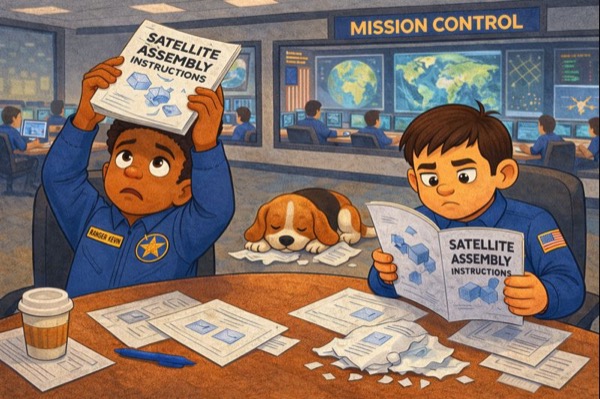
7. Give attention somewhere to go. Interest recruits attention. A problem embedded in a story or a mission gives an ADHD brain a reason to stay — which is why we build practice as space missions with a plot. It's not decoration; for this kid, it's the hook that holds.
What to skip
- Long timed drill sheets — they combine time pressure, visual clutter, and endurance demands: the exact ADHD failure stack
- Punishing incomplete sessions — you'll poison the routine you're trying to build
- Marathon weekend catch-ups — see our homework routine post for the structure that survives
Put it together
A realistic ADHD-friendly week: five short sessions, one problem visible at a time, timer running, movement between sets, and most of the minutes going to math facts — wrapped in something your child actually wants to come back to.
If those five sessions have you shopping for a program to run them with, our checklist for judging a math program covers what to look for and how the popular options — Math-U-See, Beast Academy, Kumon, Mathnasium and our own workbooks — actually measure up. Every strategy on this page works with whatever you already have, so read that one only if you are about to spend money.
Giving your child a reason to come back tomorrow is the hard part, and that is what the workbooks are built for. A story and characters your child will want to return to. Missions — worksheets, really — they will actually want to finish. The free sample is one of those missions: ten minutes, the 2s times-table set, with the answer key. The story pages come with the full workbooks on Amazon.
Send the free sample mission
The 2s times-table worksheet set from the Multiplication Workbook, with answer key — straight to your inbox.
Check your inbox!
Your free sample is on its way to . If you don’t see it, check your spam folder.
Ready for the full program? Both workbooks are on Amazon.
See the workbooks on Amazon →